

Best Performance Family Car? Why I Sold My Porsche 911 for 505HP After Dad Life Hit the Back Seat
The dream that never left

There’s always that one car. Not the practical one, not the one that fits neatly into a spreadsheet or earns a nod of approval from your insurance agent — the one that quietly colonizes your brain and never really leaves, no matter how much life changes around you. For me, that car has always been a Porsche 911.
Growing up, I had the usual posters: the Lamborghini Countach, the obscure Vector W8, the timeless Jaguar E-Type. Those were pure fantasy. But the 911 always felt different — attainable, almost. Like something you could actually chase down if you worked hard enough and wanted it badly enough. Then one afternoon in the late ’80s, a red 911 rolled past — wide hips, that unmistakable whale tail — and it didn’t try to get attention. It didn’t need to. That was the moment everything was decided.

The icons that set the standard


The air-cooled icons: Porsche 964 and 930 Turbo
As I got older, the obsession sharpened from general admiration into something more specific. It wasn’t just any 911 I wanted — it was the icons. The air-cooled magic of the Porsche 964. The slightly terrifying, boost-heavy personality of the 930 Turbo. Cars with manual transmissions and rear-engine balance that didn’t just reward skill — they expected it from you. They weren’t easy, and that was the whole point. The difficulty wasn’t a flaw; it was the feature.
Reality hits (right on schedule)

At some point, you stop dreaming and start shopping. And that’s exactly when reality shows up uninvited. Getting into an air-cooled 911 today — even a legitimate driver’s car rather than a trailer queen — means stepping into a price bracket that doesn’t stretch your budget so much as quietly mock it. There are projects out there, sure: cars that need love, time, and money — usually all three simultaneously. But that was never the goal. I didn’t want a project car or a museum piece to admire from the driveway while heading to a soccer game in something sensible. I wanted a car I could actually drive.

The pivot: finding the last analog 911


That reality check led me to the Porsche 997, and in a lot of ways, it felt like landing exactly where I was supposed to be. The 997 is, to my mind, the last of the truly analog 911s — the final generation before the driving experience became mediated by layers of digital sophistication. I have nothing against the 996; I respect it, and if the right one appeared, I wouldn’t turn it down. But the 997 always felt right in a way that’s difficult to articulate but impossible to ignore.
The round headlights came back. The hydraulic steering actually communicated what the front wheels were doing. The six-speed manual felt mechanical rather than simulated. There was just enough technology to be useful without ever threatening to take over the experience. It didn’t try to be everything, and it didn’t need to be.
“Every input mattered. Every shift had weight. Every mile felt intentional. No filters, no artificial layers — just you, the machine, and the road ahead.”
When life outgrows a sports car
Cars don’t exist in isolation. They exist inside real lives — driveways, kids, schedules, and responsibilities that have absolutely no interest in your preferred transmission type. For a while, I convinced myself the 997 could stretch into daily duty. Technically, you can fit a car seat in the back — “fit” doing a considerable amount of heavy lifting in that sentence. But eventually, a 2-year-old and a 13-year-old both develop legs, and suddenly that clever geometric workaround collapses into a genuine problem. Space disappears. You start staring into the rearview mirror wondering how long you can keep pretending this still works. Lord help me, I thought. I don’t want to drive a minivan.
At the same time, something else starts creeping in: the hunger for more power. The 997 Carrera 3.6L I’d bought came with Tubi mufflers, headers, and an APR tune, and it was genuinely good. But once you’ve lived with something, you start wondering what’s on the other side of “just a little more.” Engine builds at shops like Slakker Racing run $30,000 or more. Forced induction conversions through VF Engineering add another $10,000-plus to the equation. Or you simply step into an entirely different price bracket. At some point, you have to ask yourself: am I enjoying the car, or am I trying to force it into something it was never meant to be?
The shortlist: every logical answer, and why it wasn’t enough
| Car | Performance | Practicality | Price (used) | Verdict |
|---|---|---|---|---|
| Audi RS6 Avant | Twin-turbo V8, Quattro AWD | Wagon — excellent | $80,000+ | Dream, but pricey |
| Porsche Cayenne GTS | Fast, composed | SUV — excellent | $65,000+ | Too practical |
| Panamera Sport Turismo | Porsche DNA, fast | Hatch — very good | $70,000+ | Sensible, not exciting |
| BMW M3 | Inline-6, fast | Sedan — good | $55,000+ | No emotional pull |
| Alfa Giulia QV ✓ | 505hp Ferrari V6, RWD | Sedan — good | $45,000–$55,000 | The one |
The Audi RS6 Avant was the dream solution — twin-turbo V8, legendary Quattro AWD (especially relevant for Michigan winters), and wagon practicality that makes most SUVs feel superfluous. It’s the enthusiast dad’s cheat code, until you check the price. The Cayenne does everything right but, if your household already runs a full-size SUV, adding another one isn’t a solution — it’s surrender. You don’t need two refrigerators, even if one of them does 0–60 in under four seconds. The Panamera Sport Turismo made perfect sense in all the right ways, but started to feel less like discovery and more like negotiation. And the M3 checked boxes on paper without ever pulling you in emotionally — and that matters more than most people admit.
The wildcard: Alfa Romeo Giulia Quadrifoglio

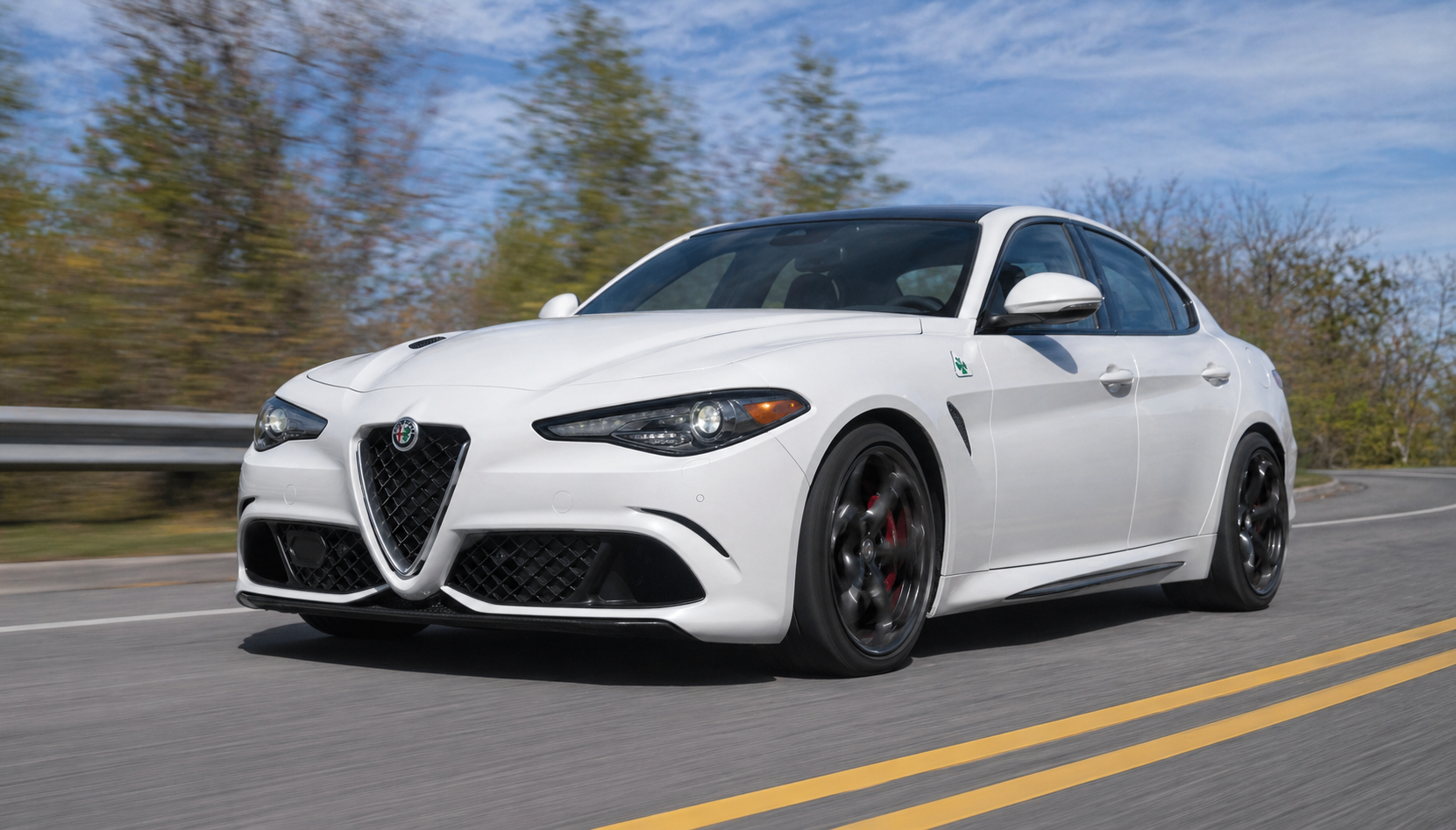
And then, almost by accident, I found it. The Alfa Romeo Giulia Quadrifoglio is not the safe choice — not the recommendation most forums will hand you when you explain your situation. But it has something none of the others could offer: genuine character. Five hundred and five horsepower from a Ferrari-influenced twin-turbo V6, rear-wheel-drive balance, and styling that still looks fresh years after its debut. It feels like what BMW used to be before things got complicated — alive, raw, and engaging in a way that makes you want to find the long way home.
Yes, the concerns are real. The Alfa service network can be inconsistent depending on where you live, maintenance requires more planning than a German alternative, and an extended warranty isn’t just recommended — it’s essentially part of the purchase price if you’re being honest with yourself. But none of that changes what happens when you sit behind the wheel and drive it the way it was meant to be driven.
The nine-hour test that settled everything
The real proof came on a nine-hour drive across Pennsylvania and Ohio and back into Michigan. Thirty miles per gallon at an average of 79 mph — let’s keep that between us — from a 505-horsepower sports sedan. Numbers that simply don’t add up on paper and yet happened in the real world. More importantly, it didn’t feel like a compromise for a single mile of it. The steering was confident and direct. The ride was composed enough for genuine long-distance comfort. And with a quick flip into Dynamic mode and a touch of the paddles, the car transformed into something that had no business being as fast as it felt.
“It’s two cars in one: calm and composed when you need grocery runs and school pickups, and aggressive and alive when the road opens up and you want to remember why you got into this in the first place.”
The moment that made it real
Then came the actual test: the car seats. The kids. And this time, they didn’t struggle to fit — they just fit. No compromises, no creative positioning, no mental geometry every time you open the rear door. That was when it clicked. This wasn’t a downgrade. It wasn’t a concession to practicality or a retreat from what makes driving worth caring about. It was the right move.
In a market where performance cars keep getting heavier, more digital, and increasingly detached from the person behind the wheel, the Giulia stands out for the exact opposite reasons. It’s analog in the ways that matter, digital only where it helps, and engaging in a way that reminds you what drew you to cars in the first place. It’s better than advertised, better than expected, and better than its reputation suggests.

You don’t stop wanting a 911. That never goes away — the sound, the feel, the rear-engine connection. Those things don’t get replaced, they get deferred. But life doesn’t pause politely while you wait for the perfect spec at the perfect price to appear in the right market at the right moment.
The Giulia Quadrifoglio didn’t replace the 911 dream. It preserved it — by making sure this chapter of driving life didn’t have to be defined by a minivan or a sensible crossover. The 911 is still out there. The plan is still alive. But in the meantime, there’s an Italian sports sedan in the driveway that makes you look back every time you park it, and still makes you want to take the long way home. That, it turns out, is exactly enough.
Before you sign anything, run through this. The Giulia rewards buyers who do their homework — and punishes those who don’t.


Click any image to enlarge
Speed-Luxury.com — Enthusiast Drives


