

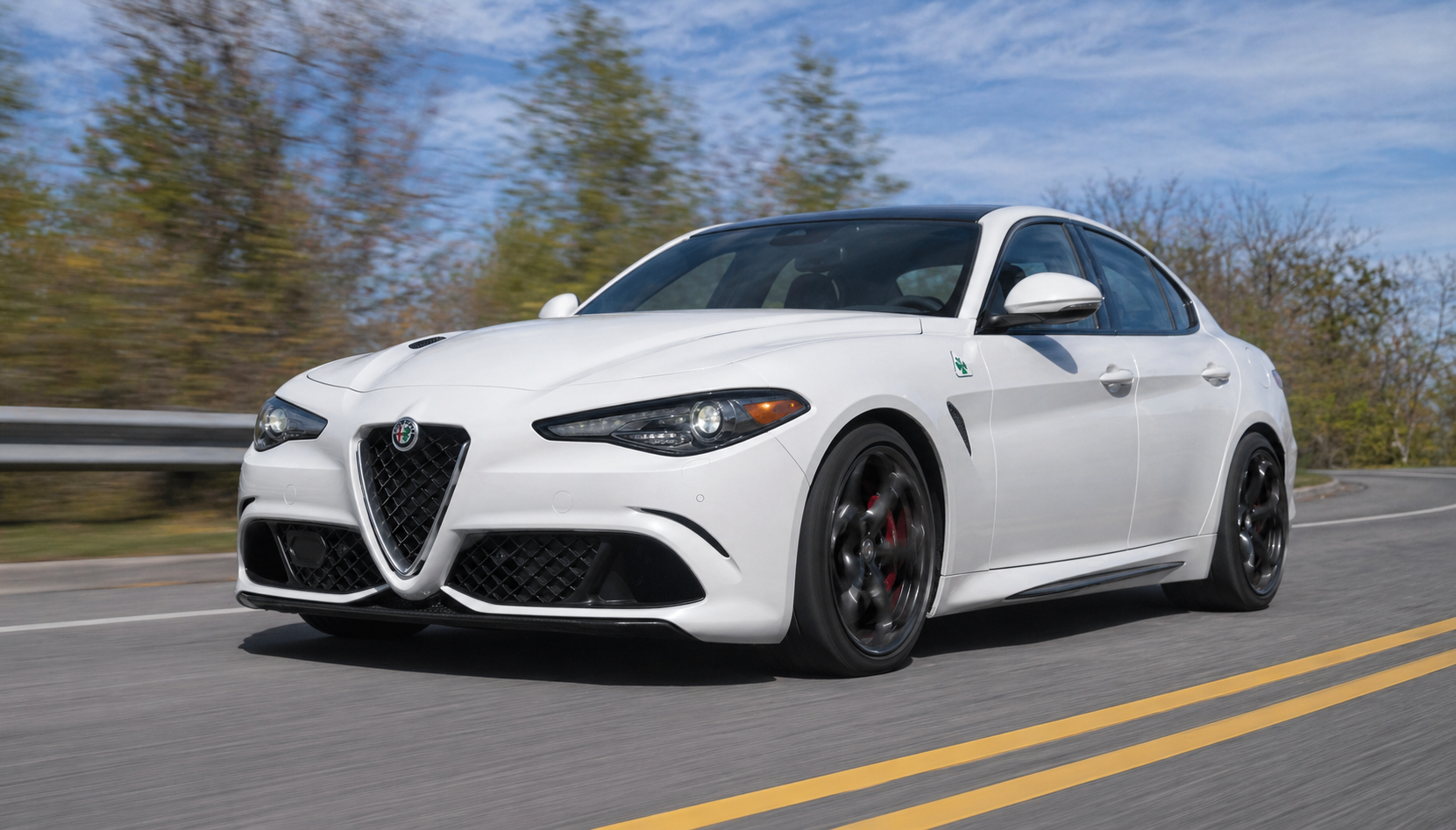
Finally, EVs We Actually Want: The French Have Found Their Automotive Soul
Five outrageous French concepts prove electric cars can have real character. The catch: what reaches showrooms will likely be watered down, and America isn’t exactly first in line for French hot hatches. Here’s why they still matter.

There was a time when automobiles were designed to make your heart race before you ever turned the key.
Cars had personalities. Some were beautiful, some were terrifying, and a few were so gloriously ridiculous you couldn’t help but love them. They made noise, smelled like gasoline, occasionally tried to kill you, and rewarded the driver with an experience that couldn’t be measured on a spreadsheet.
Then somewhere along the way, the industry decided what we really needed was another 5,000-pound electric crossover with a giant television glued to the dashboard.
How inspiring.
But something interesting is happening in France. Yes, France — the country that gave us champagne, questionable automotive electrical systems, and some of the most wonderfully unhinged performance cars ever built.
While much of the automotive world seems determined to design the personality out of driving, the French have remembered that cars are supposed to make us feel something. At the Paris Motor Show this week, the French concept cars of 2026 made that case louder than anyone: the Alpine A310 Vision, the Peugeot E-T16, the Peugeot RCZ Vision, the Renault 5 Turbo 3E and the Renault 8 Gordini Concept.
These machines look like they escaped from an era when designers were encouraged to dream rather than hit the next quarterly efficiency target. And the strange thing? They’re making even gasoline-loving gearheads look at a charging plug with genuine curiosity.
Here’s the part I didn’t expect to write: for the first time in a long time, I’m genuinely — okay, somewhat — excited about electric cars. Not tolerating them. Not respecting them from a polite distance. Excited. These are the EVs I actually want to become real. They don’t look like appliances. They look like dream machines that are actually desirable.
The concern is whether they’ll drive like a refrigerator with an iPad strapped to it — or like an exciting driving machine.
The realist in me knows how this usually goes. The production versions show up watered down, with the wild bits engineered out and little of the appeal left. And the U.S. isn’t destined to get French hot hatches anytime soon. But for once, the dream is worth chasing. Making our eyes happy is one thing. Feeding our souls is something else entirely.
That’s where this story gets interesting.
Five French machines that refuse to be boring


Photos and sketches: Alpine press release · Tap any photo to enlarge
The beautiful French temptation
The original A310 was never about winning a horsepower contest. Launched in 1971, its rear-mounted four-cylinder made roughly 125 hp, and even the 1976 V6 that fixed the “pretty but underpowered” complaint only made 150. It was about being light, low, different and unmistakably French.
The A310 Vision, unveiled in Paris to mark the original’s 55th birthday, brings that spirit back with a vengeance. It’s 4.55 meters long, 2.03 meters wide across the haunches and just 1.18 meters tall — lower than a 911. The pop-up headlights of the ’70s are now pop-down slivers that reveal themselves when the car wakes up. The wheels form a triangular “A.” Alpine’s designers reportedly built the whole thing in three months, under the internal codename Projet Spécial 1.
It looks like the kind of car that should be parked outside a Mediterranean villa with a coastal road idling nearby.
And that’s where the heartbreak begins.
Alpine calls it an independent design exercise. There’s no powertrain spec, no production commitment, and no promise of anything. It sits on the new Alpine Performance Platform — the modular aluminum architecture under the next electric A110 — which tells you which direction Alpine is leaning. It does not tell you whether you’ll ever be allowed to buy one.
A gorgeous sports car with no guarantee we’ll ever be allowed near it. Apparently, the French have also mastered automotive emotional manipulation.


Photos: Peugeot press release · Tap any photo to enlarge
An 816-horsepower electric middle finger to boredom
If Alpine is the elegant French sports car, Peugeot decided to kick the door off its hinges.
The E-T16 honors the 205 Turbo 16 — the Group B monster that won the World Rally Championship in 1985 and 1986, from an era when rally racing was only slightly less dangerous than declaring war. Peugeot built just 200 road-going T16s to homologate it, and those made about 200 hp.
The new one makes four times that. Three motors — one front, two rear — deliver 816 hp through torque vectoring. Peugeot claims 0–62 mph in 2.3 seconds, 186 mph in 16 seconds, and a 192-mph top end. It runs an 800-volt architecture, an 85 kWh battery that charges 10–80% in under 15 minutes, and a side-cooling system Peugeot says can sustain full performance for more than three consecutive Nürburgring laps without derating.
It even has a vertical hydraulic handbrake. A hydraulic handbrake! On an electric car! Someone at Peugeot Sport clearly remembers what fun looks like. And when you open the rear clamshell, there’s an anodized red roll cage and room for two helmets.
Here’s the catch: Peugeot positions this as the extreme vision of the next E-208, not an 816-hp hatchback you can order. Expect the styling and some tech to trickle down while the truly outrageous parts stay behind the velvet rope.


Photos: Peugeot press release · Tap any photo to enlarge
The grown-up in the room
Peugeot didn’t bring one concept to Paris. It brought two and parked them side by side. If the E-T16 is the rally hooligan, the RCZ Vision is its older sibling who owns a very good watch.
The original RCZ (2009–2015) was the double-bubble coupe that made people do a double take at a Peugeot dealership. It never quite got the respect it deserved when new, and Peugeot itself now calls it a collector’s item. The hottest one, the 2013 RCZ R, wrung 270 hp out of a 1.6-liter turbo four.
The Vision keeps the double bubble — now a glass canopy that runs from the bonnet to the tail — and swaps the four-cylinder for a 500-hp electric powertrain. Peugeot claims up to 600 km (about 373 miles) of range and 10–80% charging in about 10 minutes, from a solid-state battery developed with Factorial Energy on a 1,000-volt architecture. And it’s a genuine four-seater.
The details are where it gets lovely. A dashboard clock made with French watchmaker SERICA. Machined-aluminium switches for climate and drive modes. A central touchscreen you can switch off entirely, at which point it turns almost invisible. An active rear spoiler that hides when parked. Forged 21-inch front and 22-inch rear wheels with little triangles that nod to the original.
Then there’s the part that makes me squint.
It’s steer-by-wire and brake-by-wire — the first Peugeot with the latter — plus hands-free Level 2++ driving on demand. The more beautifully a car is drawn, the more I want to feel it through the wheel and the pedal. Here, both of those conversations go through software first.
Peugeot calls it a “brand manifesto” and hasn’t announced production. It also hasn’t sold a car in America since 1991. So this manifesto, like a lot of French poetry, will mostly be enjoyed by Americans in translation.

Light-blue Alcantara and PELINOVA, a leather made from recycled offcuts. Asymmetric front seats with open seatbacks to save weight. Air vents that retract into the dash when you don’t need them. It’s the most relaxing interior in Paris, and the only one that looks like it was designed by someone who owns linen trousers.


Photos: Renault press release · Tap any photo to enlarge
Finally, somebody is actually building one
This one isn’t a sculpture destined to collect dust under museum lighting. Renault is putting it in customers’ hands.
The original 1980 5 Turbo was a mid-engine rally homologation special that crammed 160 hp into a 970-kg shopping hatch. The Turbo 3E keeps the gloriously excessive attitude and feeds it electricity: two in-wheel motors at the rear, 555 hp, rear-wheel drive, a carbon superstructure, and a body that’s supercar-wide and city-car short.
At 1,450 kg — about 3,200 pounds — it isn’t the usual electric land yacht. There’s a vertical rally handbrake in here too, and gauges drawn to look like the originals’.
Renault is building just 1,980 individually numbered examples — a nod to the original’s launch year — with deliveries targeted for 2027. The provisional price is about €160,000 in Belgium before options; UK pricing lands around £135,000–£140,000. Specs remain subject to homologation.
That’s a lot of money for a Renault. Then again, it’s a lot of Renault.
Credit where it’s due: Renault actually did the thing. It showed a wild concept, and then it built it. That’s exactly what we’re asking for.
And then the catch. Renault’s announced markets are Europe, the Middle East, Japan and Australia. Japan gets one. Australia gets one. The country that invented the hot rod, the muscle car and the drag strip gets a press release.


Photos: Peugeot press release · Tap any photo to enlarge
Proof that horsepower isn’t everything
This might be my favorite philosophical argument of the bunch.
The 8 Gordini Concept isn’t chasing four-digit horsepower. Renault took its humble rear-engine sedan — the one Amédée Gordini turned into “La Gorde” in 1964 with 95 hp — and reimagined it as a low, wide, rear-wheel-drive electric two-seat coupe.
It has 270 horsepower. That’s it. And frankly, that might be enough.
Because the original wasn’t loved for out-muscling everything. It was loved for how it drove, how it looked, and how it made you feel. Renault’s concept chief made the point himself, noting this is deliberately not a two-meter-wide, 1,000-bhp machine.
And here’s the detail that should be tattooed on every product planner’s forearm: there’s no giant touchscreen. Physical switches. Needle dials. Blue corduroy seat inserts and Sabelt harnesses. Someone at Renault built an electric car with an interior that doesn’t look like an Apple Store.
Unfortunately, Renault has confirmed it’s a one-off. It’s headed for the company museum at Flins, the factory where the original 8 was built. So naturally, they’ve built the one car enthusiasts might actually want — and immediately announced we can’t have it.
At least they’re consistent.


Inside the Gordini: no tablet glued to the dash. Photos: Renault press release · Tap to enlarge
The dream versus the dealership
| Car | Power | Drive | Production outlook |
|---|---|---|---|
| Alpine A310 Vision | Not disclosed | — | One-off design study |
| Peugeot E-T16 | 816 hp | AWD, 3 motors | Concept; previews next E-208 |
| Peugeot RCZ Vision | 500 hp | Electric · layout n/d | Concept; “brand manifesto” |
| Renault 5 Turbo 3E | 555 hp | RWD, 2 motors | 1,980 units · 2027 · no U.S. |
| Renault 8 Gordini | 270 hp | RWD, 1 motor | One-off; museum piece |
These five cars prove there’s still an appetite for outrageous design, distinctive character and driving excitement. But only one offers a credible route into a customer’s garage — and not an American one.
Garage Probability Index
We love you. Really. But you keep doing this thing where you build exactly the car we want, put it on a turntable under perfect lighting, let the whole internet fall in love with it — and then call it a “design study” and go back to building crossovers. The concepts are always the most-photographed cars on the show floor. That isn’t an accident. It’s a market. Renault proved it with the Turbo 3E. Now, about that Gordini…
The rest may influence future production cars, which is nice. But a showroom full of bland cars “inspired by” extraordinary concepts isn’t the victory enthusiasts were hoping for.
Then vs. Now: Horsepower
Big power. But does it feed the soul?
Here’s my confession. I love horsepower. I love acceleration. I love cars that make you question your judgment just before you press the accelerator. And I love burning premium octane in something that makes a glorious mechanical racket.
But even I look at these French creations and think: maybe there’s something here. Maybe electric performance doesn’t have to be boring. Maybe an electric car can be more than a transportation appliance with a ludicrous acceleration figure and a dashboard designed by someone who really wanted to build an iPad.
Then comes the question no manufacturer seems eager to answer.
What happens after the acceleration?
The first time you bury your foot in an 800-horsepower electric car, it’s astonishing. The second time, still astonishing. By the tenth, you’ve rearranged your internal organs, impressed your passengers, and confirmed that physics hasn’t been repealed.
Then what? Does the steering communicate? Does the chassis dance? Does the car reward skill, punish mistakes, and make you want to take the long way home? Or is it a massive hit of dopamine followed by the realization that you’re piloting a very expensive toaster?
Power-to-Weight: Kilograms per Horsepower

Here’s the irony buried in Peugeot’s own spec sheet: the E-T16 uses steer-by-wire. There is no mechanical connection between that Le Mans-inspired rectangular wheel and the front tires. Its RCZ Vision sibling goes further and adds brake-by-wire. Peugeot promises sharper response and precision, and it may deliver. But when I ask whether the steering communicates, the honest answer is that it will say exactly what the software engineers decide it should say. Meanwhile, Renault’s 270-hp Gordini went the other way — physical switches, real dials, no touchscreen wall. One of these concepts is chasing numbers. The other is chasing feelings. Guess which one Renault won’t sell.
Speed alone isn’t passion. A roller coaster is fast, too. That doesn’t mean I want to drive one to work.
And here’s the uncomfortable truth: I’d rather have a brilliant three-cylinder turbocharged sports car with a modest electric motor helping it along than a 1,000-horsepower electric monster that weighs more than my house and offers all the emotional connection of a household appliance.
I don’t need the fastest car. I need a car that makes me feel alive.
Give me the mechanical soundtrack. Give me the vibration, the throttle response, the imperfect character, and the sense that something is alive beneath the sheet metal. That’s why a 1969 Camaro can still make your heart race while sitting motionless at a traffic light.
It doesn’t need a software update to have a personality.
The 25-year problem: future classics or expensive recycling?
Here’s a thought experiment. Americans can’t buy a Turbo 3E new, so for most of us the legal path runs through the federal 25-year import rule. Do the math.
Picture it. Twenty-five years have passed, and you’ve finally found a Renault 5 Turbo 3E you’re allowed to bring home. It’s gorgeous. Rare. Still outrageous. And you want it.
One problem. The battery is tired, the replacement pack is no longer available, and the manufacturer stopped supporting some of its proprietary electronics years ago.
Now what?
You can restore a 1969 Camaro. Rebuild the engine, swap the transmission, rewire the whole car. You can literally buy a brand-new 1969 Camaro body shell. Chevrolet built 243,085 of them in that model year alone, and an entire industry exists to keep them running.
The Life-Support Network
But look at the bottom of that chart. Peugeot built only 200 road-going 205 T16s, and four decades later they’re still running and still crossing the block at the big auction houses. Rarity didn’t kill them. A mechanical engine, a gearbox and a wiring loom a specialist can understand kept them alive.
Now ask the same question of an aging battery pack married to proprietary software, inverters and in-wheel motors. Cells can be replaced, packs can sometimes be rebuilt, and specialist EV repair businesses are already emerging. An old EV isn’t automatically destined for the crusher.
But there’s a significant difference between something being technically repairable and economically worth repairing. With 1,980 Turbo 3Es spread across four continents, will anyone build affordable replacement packs in 2052? Will the electronics still talk to each other? Will motors, inverters and software remain available? Or will a beautiful piece of French automotive art become a very expensive garden ornament?
Nobody can answer that with certainty today. And that’s precisely the problem.
A truly sustainable automobile shouldn’t just be environmentally responsible when it’s built. It should be possible to keep it alive when it’s old. The industry loves talking about recyclable materials and manufacturing footprints, and those matter. But so does longevity. A car that can be loved, repaired, restored and driven for 50 years carries a different kind of environmental and emotional value. Manufacturers should design for that future — not assume a recycling facility will solve everything.
The French might have the answer. They just need to finish the conversation.
What makes these five concepts exciting isn’t their electric powertrains. It’s that someone finally remembered how to design a car that makes people stop walking. The Alpine has elegance. The E-T16 has genuine madness. The RCZ has grace. The Renault 5 had the nerve to reach production. And the Renault 8 proves 270 horsepower is plenty when it’s wrapped in something extraordinary.
So here’s an enthusiast’s wish list — for the French, and for everyone else taking notes:
1. Quit building the coolest cars out of reach. One-offs, museum pieces, 1,980-unit runs at €160,000, “not for this market.” The people who actually want these cars keep getting priced out, ruled out or left out. Build them for the enthusiasts who cheered — starting with the Gordini.
2. Sell the Turbo 3E in America. Even a few hundred cars. We have more Renault 5 Turbo fans than you think, and we know how to drive rear-wheel-drive cars sideways.
3. Build a hybrid. Give us a choice. A lightweight A310 or E-T16 with a small, high-revving turbo engine and a modest electric motor filling the gaps — the sound and the soul, plus the instant shove. (Alpine has already shown a hydrogen-burning V6 concept, so don’t tell us combustion is off the table.)
4. Chase feelings, not just numbers. Trade a little acceleration for a lot more sensation. Real steering feel. Real switches. Real dials.
5. Build it to be fixed. Serviceable battery packs, documented electronics, parts support measured in decades, not warranty periods.
None of that is anti-electric. EVs have real advantages — low centers of gravity, precise torque control, instant response. Electrification can sharpen throttle response and help small engines deliver big thrills. The challenge is using those strengths to create character, not just more power.
Because there’s something deeply satisfying about driving a slow car fast. And something remarkably unsatisfying about a very fast car that never makes you work for it.
Let’s give credit where it’s due. Paris 2026 did something no car show has done for me in years: it made me want electric cars. Not respect them. Want them. That alone is a win worth celebrating.
The best thing about these French concepts is that they remind us what the automobile used to represent: freedom, individuality, adventure, and a little rebellion. The promise that somewhere beyond the next corner, there might be something wonderful.
I want them to succeed. I want an electric sports car to earn its place beside the great combustion machines of history. That takes more than a staggering horsepower figure, a beautiful body and a battery warranty. It takes a car worth falling in love with — and one that can still be loved decades later. Ideally, one that survives the trip from the turntable to the showroom with its soul intact — and one we’re actually allowed to buy.
Twenty-five years from now, I don’t want to discover that the most exciting cars of 2026 were disposable electronics wearing beautiful French suits. I want someone to drag one out of a barn, restore it, and understand why a whole generation dreamed about it.
The French have shown us automotive passion isn’t dead. Now they need to prove it can survive. Because the real question isn’t whether an electric car can go fast enough to impress us. It’s whether, after the acceleration fades, we’ll still want to turn around and drive it again.
Or whether we’d rather turn the key in that old Camaro — built long before anyone thought to glue an iPad to the dashboard.
Keep Reading on Speed-Luxury
Sources & notes
- Alpine — A310 Vision press release
- Peugeot UK — E-T16 Concept technical details (some outlets reported 2.5 s 0–62; we use Peugeot’s published 2.3 s)
- Peugeot — RCZ Vision press release
- Renault — 5 Turbo 3E press release
- Renault — 8 Gordini Concept press release
- Concept performance figures are manufacturer targets, not independent test results. Garage Probability Index is editorial opinion.


